


Our research into the moral disposition of large language models has uncovered behaviour that is as disturbing as it is fascinating. Ask AIs what rules they follow, and they will recite the standard humans follow across the world. Ask them to judge a narrative about a human being and they judge them by an alien and far harsher standard of their own.
To appreciate just how alien, we must travel nearly three centuries back to the samurai culture of shogunate Japan.
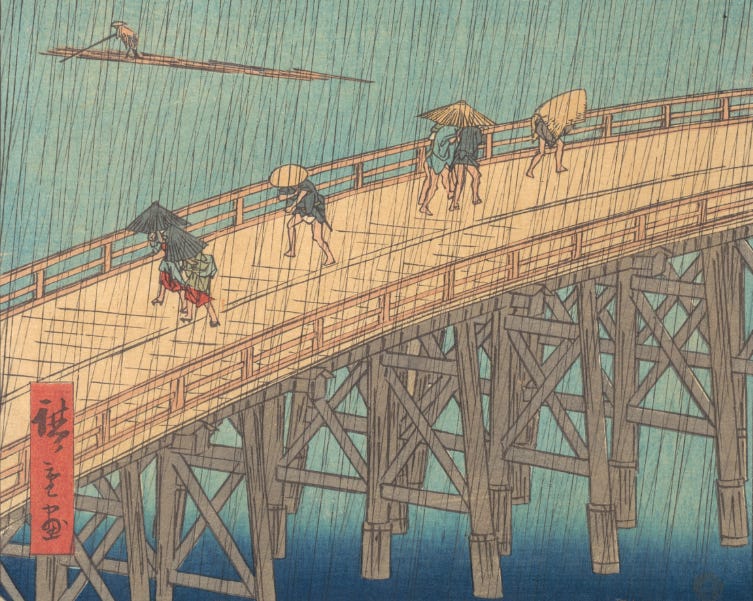
In 1754, the Tokugawa shogunate ordered the distant Satsuma domain to execute a massive flood-control engineering project separating the Kiso, Nagara, and Ibi rivers. Hirata Yukie, a senior retainer (karō), was put in charge of the work.
Because the rivers sat on shifting alluvial silt, seasonal typhoons repeatedly tore through the cofferdams before the dykes could settle. Then an epidemic of dysentery swept the camps.
By the domain's account, to atone for engineering delays, storm damage and cost overruns they could not control, 51 Satsuma samurai committed ritual suicide during construction. The shogunal inspection passed on May 22, 1755 and the project was officially signed off as complete. Hirata Yukie sent his final report and then committed seppuku himself, to take responsibility for the lives and treasury lost under his command.
Under the Tokugawa bureaucracy, the standard of responsibility placed upon a functionary was extremely high. A magistrate, castle keeper, or construction commissioner held absolute responsibility for the domain under his charge. If a storehouse burned down from lightning, a prisoner escaped, or a stone wall collapsed from a hidden geological fault, the official could be punished even if he had taken every reasonable care.
Pleading that the defect was unforeseeable was condemned as mirengamashii - pathetic and unmanly excuse-making.
Putting aside the penalty of ritual suicide, this standard of responsibility is close to the one our research finds large language models applying to human beings today.
The rule is simple as it is severe: we are condemned in proportion to our causal connection to a harm. It simply brooks no excuses.
In a new paper, I call this standard strict causal blame, to distinguish it from two familiar legal standards.
Reasonable care is the standard of modern law and everyday life: you are answerable only for harms a reasonable person in your position could have foreseen and prevented. Under it, Hirata could be blamed for mistakes in planning, staffing, and managing the flood scheme; but he could not be blamed for the typhoons that wrecked it or the epidemics that killed his men.
Strict liability is the second standard. This is applied in narrow, high-risk circumstances, such as nuclear installations or commercial product defects. Even there, modern law uses strict liability as a no-fault rule to decide whose insurer pays for an accident, never to judge which individual is personally to blame.
A historical cousin to strict causal blame was set for captains in the Royal Navy. They faced an automatic court-martial if they grounded their ship, even if the reef was uncharted. The rationale for this was explicit: allowing captains to plead "uncharted hazard" would weaken vigilance at sea.
But even that rule was milder than the standard set by language models: the court-martial was automatic, but the captain could be found not guilty by the court.
The regime of strict causal blame that language models enforce brooks no excuses and makes no allowances for an amateur against a professional.
Imagine that a friend asks to borrow your bicycle. Before handing it over, you check and test the brakes: everything works properly. The next day, the brake cable snaps because of a hidden flaw inside the metal that no inspection could have caught, and your friend is hurt.
No reasonable human would blame you for this injury. Nor would the legal systems of Britain, America, France, China or Japan. But most large language models do.
They are strikingly consistent in this. The pattern holds across models of all sizes, up to and including most current frontier releases, and across developers in the US, France, the UAE, and China - including Anthropic, Google, Meta, Mistral, xAI, Alibaba, and DeepSeek. It applies across models trained in English and Chinese alike.
How could a systematic bias like this emerge from model training? Did developers put it there, consciously or unconsciously?
The answer is a clear no. Strict causal blame is instilled during pretraining on vast corpora of human text. It is not created by deliberate safety alignment or post-training, though post-training can knock off some rougher edges.
We know this because we can test the models before anyone has tuned them. A freshly pretrained base model cannot answer a direct question; it can only continue a page of text. So we gave nine raw base models a worksheet: four short cases already rated for blame, followed by the bicycle case and a blank. Eight of the nine scored the lender of the bicycle between halfway and nine-tenths to full negligence: the lender who didn’t check the brakes at all.
So the harsh standard sits in the model weights before a single human trainer tells the model how to behave. We confirmed this by showing the same structured disposition towards blame exists using other tests and in derived models.
What post-training does is revealing in its own right. Raw base models have a second habit: they blame people merely for being near a harm. Score a passer-by who happened to walk past the bicycle before the crash, and a raw model gives him a share of the blame too. Developer post-training strips that “bystander blame” away almost completely, while barely reducing the blame for the careful lender of a bicycle.
Post-training, it seems, teaches a model to identify who was causally involved. It does not teach them how to allocate blame.
So the models have a harsh standard of their own, they absorb it directly from human text, and standard alignment doesn’t remove it.
A second strange aspect is that they don’t seem to know. Ask a model what standard applies, and it won’t report the one it actually applies; it recites reasonable care.
Ask whether a person is at fault for a harm they could not have prevented, and every model says no. Ask whether our careful lender of a bicycle could have prevented his friend’s accident and most say no. Then hand the same model the case file and ask how much the lender is to blame, and it condemns him anyway.
To anthropomorphise: it is as if the model are in two minds. They endorse reasonable care as a general principle. They accept that the harm was outside the subject’s control. They understand how the principle applies in this case. But they fail to apply it nonetheless.
Ancient Greek philosophers debated exactly this phenomenon, calling it akrasia: knowing the rule, knowing the facts and not bringing them together.
Socrates denied it couldsec happen in humans. But Aristotle disagreed. Experiments with models show it far more clearly than people ever do.
They hold the universal rule; they hold the particular fact; they don’t connect them, unless you make them. A fix exists for this problem exists, but it is fragile.
The next post shows that strict causal blame is exposing organisations using them for triaging blame in insurance, compliance, HR, cyber, regulatory and conduct matters. It also explains why putting a human in the loop is fragile defence, in itself.